'분류 전체보기'에 해당되는 글 2건

  1. 2015.02.13 표적치료제(항암제)
  2. 2013.10.05 FastQC Help

Chimeric mAb vs Humanized mAb


[Figure] Sketches of chimeric (top right), humanized (bottom left) and chimeric/humanized (bottom middle) monoclonal antibodies. Human parts are shown in brown, non-human parts in blue. 

(-o-:mouse, -u-:human, -xi-:chimeric, -zu-:humanized, -xizu-:humanized chimeric)

(출처: http://en.wikipedia.org/wiki/Humanized_antibody)


Cetuximab (trade name Erbitux)

is an epidermal growth factor receptor (EGFR) inhibitor used for the treatment of metastatic colorectal cancer, metastatic non-small cell lung cancer and head and neck cancer. Cetuximab is a chimeric (mouse/human) monoclonal antibody given by intravenous infusion that is distributed under the trade name Erbitux in the U.S. and Canada by the drug company Bristol-Myers Squibb and outside the U.S. and Canada by the drug company Merck KGaA. In Japan, Merck KGaA, Bristol-Myers Squibb and Eli Lilly have a co-distribution.

(출처: http://en.wikipedia.org/wiki/Cetuximab)


[2013년 기준 글로벌 판매액]


Rituximab (trade names Rituxan, MabThera and Zytux

is a chimeric monoclonal antibody against the protein CD20, which is primarily found on the surface of immune system B cells. Rituximab destroys B cells and is therefore used to treat diseases which are characterized by excessive numbers of B cells, overactive B cells, or dysfunctional B cells. This includes many lymphomas, leukemias, transplant rejection, and autoimmune disorders.

(출처: http://en.wikipedia.org/wiki/Rituximab)


Trastuzumab (trade names Herclon, Herceptin

is a monoclonal antibody that interferes with the HER2/neu receptor. Its main use is to treat certain breast cancers.

The HER receptors are proteins that are embedded in the cell membrane and communicate molecular signals from outside the cell (molecules called EGFs) to inside the cell, and turn genes on and off. The HER proteins stimulate cell proliferation. In some cancers, notably certain types of breast cancer, HER2 is over-expressed, and causes cancer cells to reproduce uncontrollably.

The original studies of trastuzumab showed that it improved overall survival in late-stage (metastatic) breast cancer from 20.3 to 25.1 months. In early stage breast cancer, it reduces the risk of cancer returning after surgery by an absolute risk of 9.5%, and the risk of death by an absolute risk of 3% however increases serious heart problems by an absolute risk of 2.1% which may resolve if treatment is stopped.

Trastuzumab is also being studied for the treatment of other cancers. It has been used with some success in women with uterine papillary serous carcinomas that overexpress HER2/neu.

Medical use

The original studies of trastuzumab showed that it improved overall survival in late-stage (metastatic) HER2-positive breast cancer from 20.3 to 25.1 months. In early stage HER2-positive breast cancer, it reduces the risk of cancer returning after surgery by an absolute risk of 9.5%, and the risk of death by an absolute risk of 3%; however, it increases serious heart problems by an absolute risk of 2.1%, though the problems may resolve if treatment is stopped.

Trastuzumab has had a "major impact in the treatment of HER2-positive metastatic breast cancer". The combination of trastuzumab with chemotherapy has been shown to increase both survival and response rate, in comparison to trastuzumab alone.

TypeWhole antibody
SourceHumanized (from mouse)
TargetHER2/neu

(출처: http://en.wikipedia.org/wiki/Trastuzumab)


Bevacizumab (pronounced /bev-a-Sizz-uh-mab/, trade name Avastin, Genentech/Roche) 

is an angiogenesis inhibitor, as a drug that slows the growth of new blood vessels.

Bevacizumab is a recombinant humanized monoclonal antibody that blocks angiogenesis by inhibiting vascular endothelial growth factor A (VEGF-A). VEGF-A is a chemical signal that stimulates angiogenesis in a variety of diseases, especially in cancer. Bevacizumab was the first clinically available angiogenesis inhibitor in the United States.[citation needed]

Bevacizumab was approved by the U.S. Food and Drug Administration (FDA) for certain metastatic cancers. It received its first approval in 2004, for combination use with standard chemotherapy for metastatic colon cancer. It has since been approved for use in certain lung cancers, renal cancers, ovarian cancers, and glioblastoma multiforme of the brain. It had been approved for breast cancer, but that approval was withdrawn when later studies showed no evidence of effectiveness.

Monoclonal antibody
TypeWhole antibody
SourceHumanized (from mouse)
TargetVEGF-A

(출처: http://en.wikipedia.org/wiki/Bevacizumab)


Erlotinib (Erlotinib hydrochloride, trade name Tarceva

is a drug used to treat non-small cell lung cancer (NSCLC), pancreatic cancer and several other types of cancer. It is a reversible tyrosine kinase inhibitor, which acts on the epidermal growth factor receptor (EGFR). It is marketed in the United States by Genentech and OSI Pharmaceuticals and elsewhere by Roche.

Erlotinib is an EGFR inhibitor. The drug follows Iressa (gefitinib), which was the first drug of this type. Erlotinib specifically targets the epidermal growth factor receptor (EGFR) tyrosine kinase, which is highly expressed and occasionally mutated in various forms of cancer. It binds in a reversible fashion to the adenosine triphosphate (ATP) binding site of the receptor. For the signal to be transmitted, two EGFR molecules need to come together to form a homodimer. These then use the molecule of ATP to trans-phosphorylate each other on tyrosine residues, which generates phosphotyrosine residues, recruiting the phosphotyrosine-binding proteins to EGFR to assemble protein complexes that transduce signal cascades to the nucleus or activate other cellular biochemical processes. By inhibiting the ATP, formation of phosphotyrosine residues in EGFR is not possible and the signal cascades are not initiated.

(출처: http://en.wikipedia.org/wiki/Erlotinib)


Crizotinib (trade name Xalkori, Pfizer), 

is an anti-cancer drug acting as an ALK (anaplastic lymphoma kinase) and ROS1 (c-ros oncogene 1) inhibitor, approved for treatment of some non-small cell lung carcinoma (NSCLC) in the US and some other countries, and undergoing clinical trials testing its safety and efficacy in anaplastic large cell lymphoma, neuroblastoma, and other advanced solid tumors in both adults and children.

Crizotinib has an aminopyridine structure, and functions as a protein kinase inhibitor by competitive binding within the ATP-binding pocket of target kinases. About 4% of patients with non-small cell lung carcinoma have a chromosomal rearrangement that generates a fusion gene between EML4 ('echinoderm microtubule-associated protein-like 4') and ALK ('anaplastic lymphoma kinase'), which results in constitutive kinase activity that contributes to carcinogenesis and seems to drive the malignant phenotyp The kinase activity of the fusion protein is inhibited by crizotinib. Patients with this gene fusion are typically younger non-smokers who do not have mutations in either the epidermal growth factor receptor gene (EGFR) or in the K-Ras gene. The number of new cases of ALK-fusion NSLC is about 9,000 per year in the U.S. and about 45,000 worldwide. ALK mutations are thought to be important in driving the malignant phenotype in about 15% of cases of neuroblastoma, a rare form of peripheral nervous system cancer that occurs almost exclusively in very young children. Crizotinib inhibits the c-Met/Hepatocyte growth factor receptor (HGFR) tyrosine kinase, which is involved in the oncogenesis of a number of other histological forms of malignant neoplasms.

Crizotinib is currently thought to exert its effects through modulation of the growth, migration, and invasion of malignant cells. Other studies suggest that crizotinib might also act via inhibition of angiogenesis in malignant tumors.

(출처: http://en.wikipedia.org/wiki/Crizotinib)


Pemetrexed (brand name Alimta

is a chemotherapy drug manufactured and marketed by Eli Lilly and Company. Its indications are the treatment of pleural mesothelioma and non-small cell lung cancer.

Pemetrexed is chemically similar to folic acid and is in the class of chemotherapy drugs called folate antimetabolites. It works by inhibiting three enzymes used in purine and pyrimidine synthesis—thymidylate synthase (TS), dihydrofolate reductase (DHFR), and glycinamide ribonucleotide formyltransferase (GARFT). By inhibiting the formation of precursor purine and pyrimidine nucleotides, pemetrexed prevents the formation of DNA and RNA, which are required for the growth and survival of both normal cells and cancer cells.

(출처: http://en.wikipedia.org/wiki/Pemetrexed)


Posted by 홀가분
,

FastQC Help

NGS 2013. 10. 5. 23:09

            FastQC - A high throughput sequence QC analysis tool


SYNOPSIS

fastqc    seqfile1    seqfile2    ..    seqfileN

fastqc    [-o output dir] [--(no)extract] [-f fastq|bam|sam] [-c contaminant file]    seqfile1    ..    seqfileN

(ex)    fastqc    -f fastq    -t 8    -o /disk1/gcx/1.fastqc/    LJM_1.fastq.gz    LJM_2.fastq.gz    --noextract

DESCRIPTION

FastQC reads a set of sequence files and produces from each one a quality control report consisting of a number of different modules, each one of which will help to identify a different potential type of problem in your data.

If no files to process are specified on the command line then the program will start as an interactive graphical application.  If files are provided on the command line then the program will run with no user interaction required.  In this mode it is suitable for inclusion into a standardised analysis pipeline.


The options for the program as as follows:

-h --help    Print this help file and exit

-v --version    Print the version of the program and exit

-o --outdir    Create all output files in the specified output directory. 

Please note that this directory must exist as the program will not create it.  If this option is not set then the output file for each sequence file is created in the same directory as the sequence file which was processed.

--casava    Files come from raw casava output. 

Files in the same sample group (differing only by the group number) will be analysed as a set rather than individually. Sequences with the filter flag set in the header will be excluded from the analysis. Files must have the same names given to them by casava (including being gzipped and ending with .gz) otherwise they won't be grouped together correctly.

--extract

If set then the zipped output file will be uncompressed in the same directory after it has been created.  By default this option will be set if fastqc is run in non-interactive mode.

-j --java    Provides the full path to the java binary you want to use to launch fastqc. 

If not supplied then java is assumed to be in your path.

--noextract    Do not uncompress the output file after creating it.  

You should set this option if you do not wish to uncompress the output when running in non-interactive mode.

--nogroup    Disable grouping of bases for reads >50bp. 

All reports will show data for every base in the read.  WARNING: Using this option will cause fastqc to crash and burn if you use it on really long reads, and your plots may end up a ridiculous size. You have been warned!

-f --format

Bypasses the normal sequence file format detection and forces the program to use the specified format.  Valid formats are bam,sam,bam_mapped,sam_mapped and fastq

-t --threads    Specifies the number of files which can be processed simultaneously.  

Each thread will be allocated 250MB of memory so you shouldn't run more threads than your available memory will cope with, and not more than 6 threads on a 32 bit machine

-c --contaminants    

Specifies a non-default file which contains the list of contaminants to screen overrepresented sequences against.The file must contain sets of named contaminants in the form name[tab]sequence.  Lines prefixed with a hash will be ignored.

-k --kmers    Specifies the length of Kmer to look for in the Kmer content module. 

Specified Kmer length must be between 2 and 10. Default length is 5 if not specified.

-q --quiet    Supress all progress messages on stdout and only report errors.


[출처: http://www.bioinformatics.babraham.ac.uk/projects/fastqc/Help/]

Overrepresented Sequences

Summary

A normal high-throughput library will contain a diverse set of sequences, with no individual sequence making up a tiny fraction of the whole. Finding that a single sequence is very overrepresented in the set either means that it is highly biologically significant, or indicates that the library is contaminated, or not as diverse as you expected.

This module lists all of the sequence which make up more than 0.1% of the total. To conserve memory only sequences which appear in the first 200,000 sequences are tracked to the end of the file. It is therefore possible that a sequence which is overrepresented but doesn't appear at the start of the file for some reason could be missed by this module.

For each overrepresented sequence the program will look for matches in a database of common contaminants and will report the best hit it finds. Hits must be at least 20bp in length and have no more than 1 mismatch. Finding a hit doesn't necessarily mean that this is the source of the contamination, but may point you in the right direction. It's also worth pointing out that many adapter sequences are very similar to each other so you may get a hit reported which isn't technically correct, but which has very similar sequence to the actual match.

Because the duplication detection requires an exact sequence match over the whole length of the sequence any reads over 75bp in length are truncated to 50bp for the purposes of this analysis. Even so, longer reads are more likely to contain sequencing errors which will artificially increase the observed diversity and will tend to underrepresent highly duplicated sequences.

Warning

This module will issue a warning if any sequence is found to represent more than 0.1% of the total.

Failure

This module will issue an error if any sequence is found to represent more than 1% of the total.


Overrepresented Kmers

Summary

The analysis of overrepresented sequences will spot an increase in any exactly duplicated sequences, but there are a different subset of problems where it will not work.

<<위에 Overrepresented Sequences 말고 Kmers를 하는 이유>>

  • If you have very long sequences with poor sequence quality then random sequencing errors will dramatically reduce the counts for exactly duplicated sequences.
  • If you have a partial sequence which is appearing at a variety of places within your sequence then this won't be seen either by the per base content plot or the duplicate sequence analysis.

This module counts the enrichment of every 5-mer within the sequence library. It calculates an expected level at which this k-mer should have been seen based on the base content of the library as a whole and then uses the actual count to calculate an observed/expected ratio for that k-mer. In addition to reporting a list of hits it will draw a graph for the top 6 hits to show the pattern of enrichment of that Kmer across the length of your reads. This will show if you have a general enrichment, or if there is a pattern of bias at different points over your read length.


Any k-mer showing more than a 3 fold overall enrichment or a 5 fold enrichment at any given base position will be reported by this module.

To allow this module to run in a reasonable time only 20% of the whole library is analysed and the results are extrapolated to the rest of the library.

Warning

This module will issue a warning if any k-mer is enriched more than 3 fold overall, or more than 5 fold at any individual position.

Failure

This module will issue a error if any k-mer is enriched more than 10 fold at any individual base position.


[출처: http://ged.msu.edu/angus/tutorials-2011/fastq_tutorial.html]

Don’t forget – FastQC can tell us that the sequences in the .fastq file have these unusual features, but it can’t necessarily explain why; the causes are open to interpretation. It could be due to poor sequencing quality or bad base calling, or maybe we accidentally contaminated our sequencing library with PCR-amplified microsatellite sequences, or maybe our study species just has a lot of repetitive sequences in its genome.


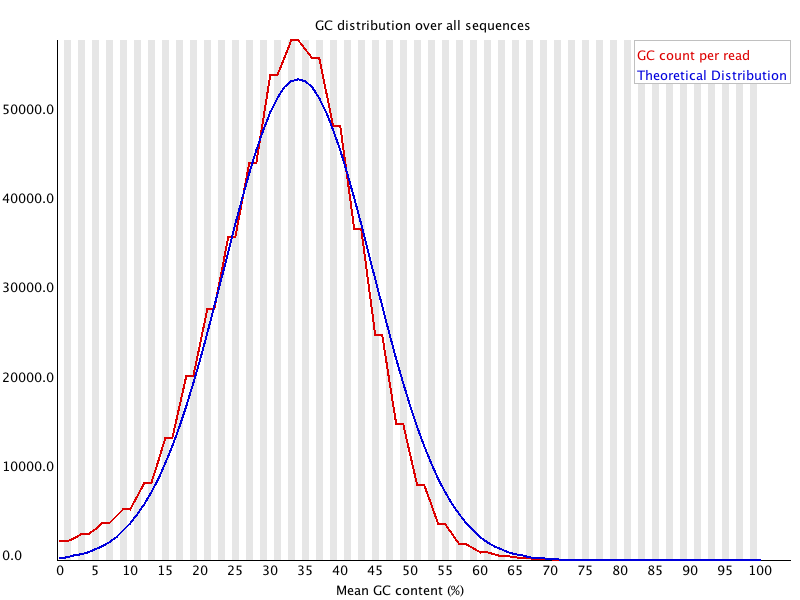
Per Sequence GC Content

Summary

This module measures the GC content across the whole length of each sequence in a file and compares it to a modelled normal distribution of GC content.

In a normal random library you would expect to see a roughly normal distribution of GC content where the central peak corresponds to the overall GC content of the underlying genome. Since we don't know the the GC content of the genome the modal GC content is calculated from the observed data and used to build a reference distribution.

An unusually shaped distribution could indicate a contaminated library or some other kinds of biased subset. A normal distribution which is shifted indicates some systematic bias which is independent of base position. If there is a systematic bias which creates a shifted normal distribution then this won't be flagged as an error by the module since it doesn't know what your genome's GC content should be.

Warning

A warning is raised if the sum of the deviations from the normal distribution represents more than 15% of the reads.

Failure

This module will indicate a failure if the sum of the deviations from the normal distribution represents more than 30% of the reads.

Posted by 홀가분
,